How it works
One screen, read top to bottom.
The verdict is at the top. The hours are underneath it. Everything else on the page is there to explain one of those two things.
Tap the stamp for the reason. Tap an hour for its wind, gusts, waves, visibility and rain. Marine locations add tides.
Personalized
One week. Three different boats.
The same seven days, rated against three sets of limits. Nothing about the forecast changes. Only the answer does.
| Vessel | Mon 4 mph |
Tue 9 mph |
Wed 14 mph |
Thu 17 mph |
Fri 24 mph |
Sat 12 mph |
Sun 7 mph |
|---|---|---|---|---|---|---|---|
| 40-foot sloop wind 6–18 mph · rain ≤ 50% |
NO-GO
not enough wind |
GO | GO |
GO*
advisory out |
NO-GO
too much wind |
GO | GO |
| 22-foot center console wind ≤ 15 mph · rain ≤ 40% | GO | GO | GO |
NO-GO
too much wind |
NO-GO
too much wind |
NO-GO
rain |
GO |
| Sea kayak wind ≤ 12 mph · rain ≤ 30% | GO | GO |
NO-GO
too much wind |
NO-GO
too much wind |
NO-GO
too much wind |
NO-GO
rain |
GO |
Illustrative figures, not a live forecast. Read down a column: the same weather, three answers. Monday stops the sloop on too little wind. Thursday clears the sloop's limits but carries an advisory, so its GO comes back marked.
Worked through
One light-air day, in detail.
Other forecasts hand all three of these boaters the same numbers. Here is what they mean to each.
The conditions: Mystic, CT, light air
- Wind, day peak
- 4 mph SW
- Gusts
- 7 mph
- Wave height
- 0.5 ft
- Precipitation
- 10%
- Visibility
- 10 mi
- Beaufort
- Force 2
40-foot sloop
- Wind 6–18 mph
- Gusts ≤ 25 mph (derived)
- Waves ≤ 4 ft
- Precip ≤ 50%
Light air. The wind tops out at 4 mph, and the sloop is slow in too little weather rather than too much. A wind speed on its own would not have told you that.
22-foot center console
- Wind ≤ 15 mph
- Gusts ≤ 21 mph (derived)
- Waves ≤ 3 ft
- Precip ≤ 40%
Wind, gusts, sea state and rain are all well inside the limits set for this boat. A flat, easy day.
Sea kayak
- Wind ≤ 12 mph
- Gusts ≤ 17 mph (derived)
- Waves ≤ 1.5 ft
- Precip ≤ 30%
The same light air that stopped the sloop makes this the best day of the week to paddle.
The other question
Not “is it good now,” but “is it good long enough.”
A GO at 10am is worth little if it closes at noon and you meant to be out until four.
How it reads
Every hour carries its own verdict, so the window is something you look at rather than something you work out. Underneath it says how long the run lasts, whether it holds past sunset, and which limit ends it.
Why it matters
Most bad days on the water are not days that looked bad. They are days that looked fine at the ramp and turned while everyone was three hours out and downwind of home. A verdict for right now cannot warn you about that. A rated timeline can.
The third stamp
Your own limits are not the only thing that can stop a day.
Aweigh reads National Weather Service marine zone products for the harbors you pick. When an advisory is in force and your limits are still met, the verdict comes back as GO* rather than a clean GO.
The alert sits above the stamp so you read it first. It is a prompt to go and read what the weather service said, not a replacement for your judgment.
Aweigh is a planning aid. Check NOAA and the Coast Guard before you get underway.
What it reads
Every number, and where it came from.
Every figure is named to its source. Nothing here is averaged together.
In the forecast
- Temperature
- Water temperature
- Average wind
- Wind gusts
- Wind direction
- Wave height
- Precipitation
- Visibility
- Tide height
- Tidal current
- Moon phase
Marine locations add the tide curve, the highs and lows, and the height right now.
Where it comes from
- Wind, gusts, temperature, visibility, daylight
Open-Meteo - Chance of rain
National Weather Service - Tides
NOAA CO-OPS, and WorldTides outside the US network - Warnings and advisories
National Weather Service marine zone products - Location lookup
Nominatim, on OpenStreetMap data
And what it does not do
Aweigh compares a forecast against the limits you set. It does not know:
- how your boat is loaded, or who is aboard
- how tired you are
- what the water looks like out the window
It is one input to a decision you are still making.
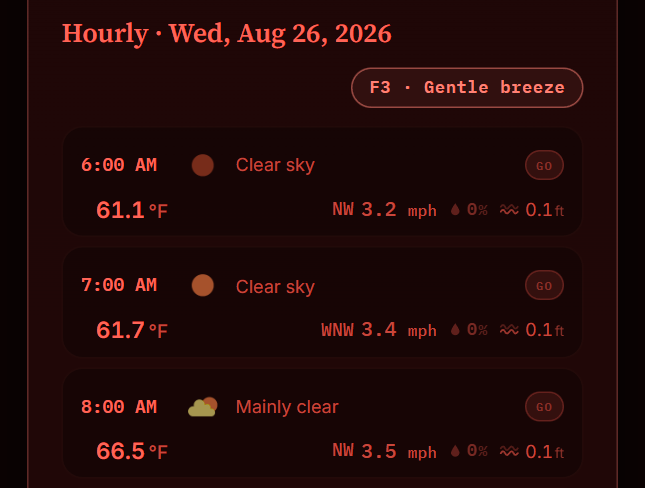
Red mode
The screen at four in the morning.
Night vision takes about twenty minutes to build and roughly one second of white screen to lose. That is the whole argument for a night palette, and it is why Red mode is not a dark theme with the brightness turned down.
Everything is still there and still readable: the stamp, the hourly rows, the tide curve. Only the palette changes. It earns its keep on the ride home after sunset as much as the pre-dawn start.
Run it for your own harbor.
Free during early access, no card, and about two minutes to set up your first vessel.